
Build Business Operating System
As Head of Strategy, Planning & Operations for the VMware SASE business unit, I inherited a newly-acquired startup with a killer product driving rapid customer acquisition — but decelerating growth, dragging renewals, and costs outpacing revenue. The LRP and AOP were treated as financial exercises: the numbers were targets, not operational plans.
The Action.
- Architected the LRP as a prioritized vision of markets to play, GTM capabilities to build, and explicitly what NOT to do — replacing an aspirational slide deck.
- Redesigned the AOP into an execution engine: revenue decomposed by driver (Geo, Route-to-Market, Product), with each function owning a number tied to one of those drivers.
- Designed the GTM capacity and resource-allocation framework, tying hiring triggers and operational investments to revenue milestones — not to functional appetite.
- Installed the operating cadence: Weekly forecast reviews to unblock sales, Monthly Business Reviews to track leading indicators, Quarterly Business Reviews to adjust team priorities.
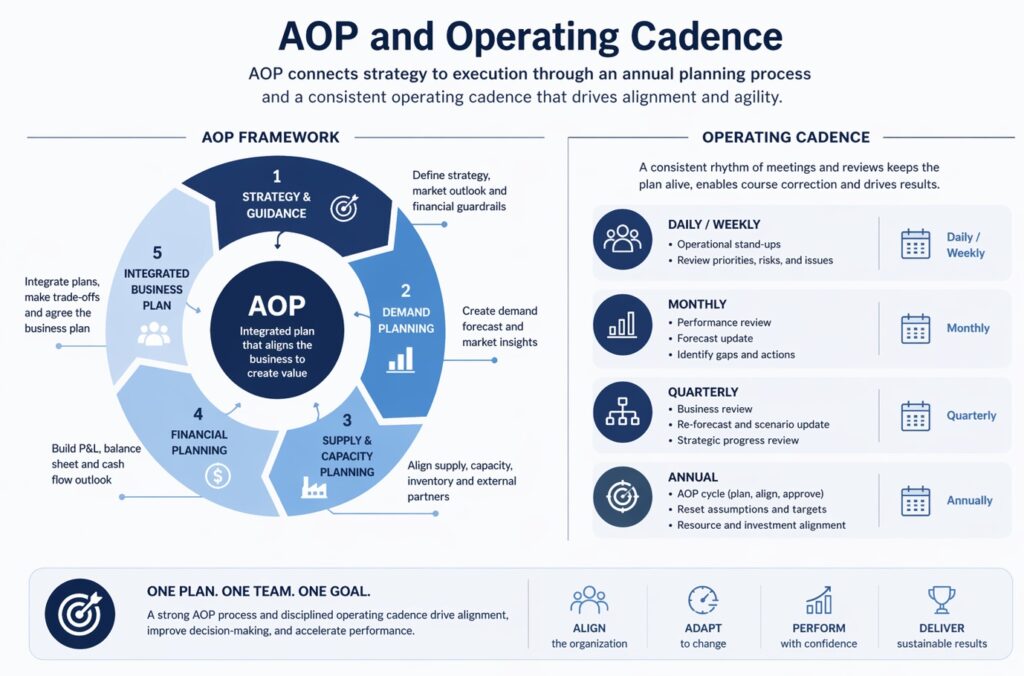
The Result. Over three years: revenue grew 200%, operating margin expanded 40 percentage points, and plan-to-actuals variance compressed from ±25% to ±5% — the operating system, not the product alone, doing the work.
Renewal Process & Retention
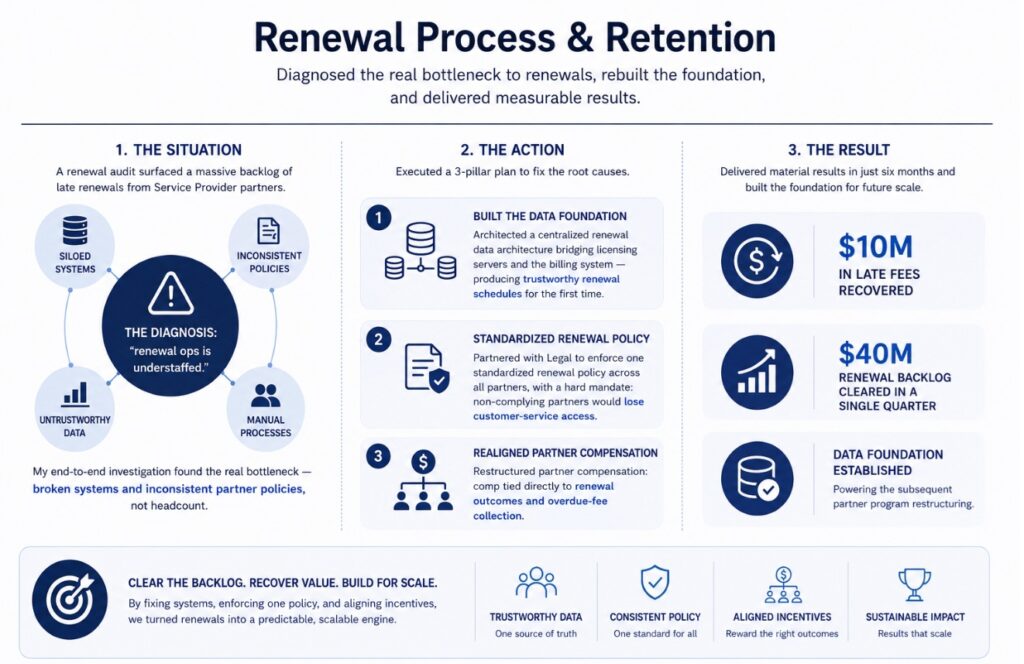
As Head of Strategy, Planning & Operations at VMware SASE, I led a renewal audit that surfaced a massive backlog of late renewals from Service Provider partners. The team’s diagnosis: “renewal ops is understaffed.” My end-to-end investigation found the real bottleneck — broken systems and inconsistent partner policies, not headcount.
The Action.
- Architected a centralized renewal data architecture bridging licensing servers and the billing system — producing trustworthy renewal schedules for the first time.
- Partnered with Legal to force one standardized renewal policy across all partners, with a hard mandate: non-complying partners would lose customer-service access.
- Restructured partner compensation: comp tied directly to renewal outcomes and overdue-fee collection.
The Result. Within six months: $10M in late fees recovered, a $40M renewal backlog cleared in a single quarter, and the data foundation powering the subsequent partner program restructuring.
Subscription Monetization & Forecastable Service Revenue
At Huawei, install-base support, feature unlocks, and version upgrades were sold à la carte. Pricing was deal-by-deal, frequently with heavy discounts granted as relationship favors to large accounts. The result: no consumption visibility, no reliable forecast for the service-revenue line, and a perpetual scramble at quarter-end to reconcile what customers had actually been granted versus what had been invoiced.
The Action.
- Architected a structured annual maintenance subscription bundling support, customer success, upgrades, and patches into a single SKU — replacing the à la carte menu.
- Tiered pricing to deployment size and customer footprint, with fixed list prices and a narrow, governed discount band — eliminating the favor-based discount layer.
- Iterated the offering with sales and a cohort of key strategic customers ahead of launch, then led the internal operational rollout across Quoting, Order Management, Renewals, Finance, and Customer Success to put the new model into production.
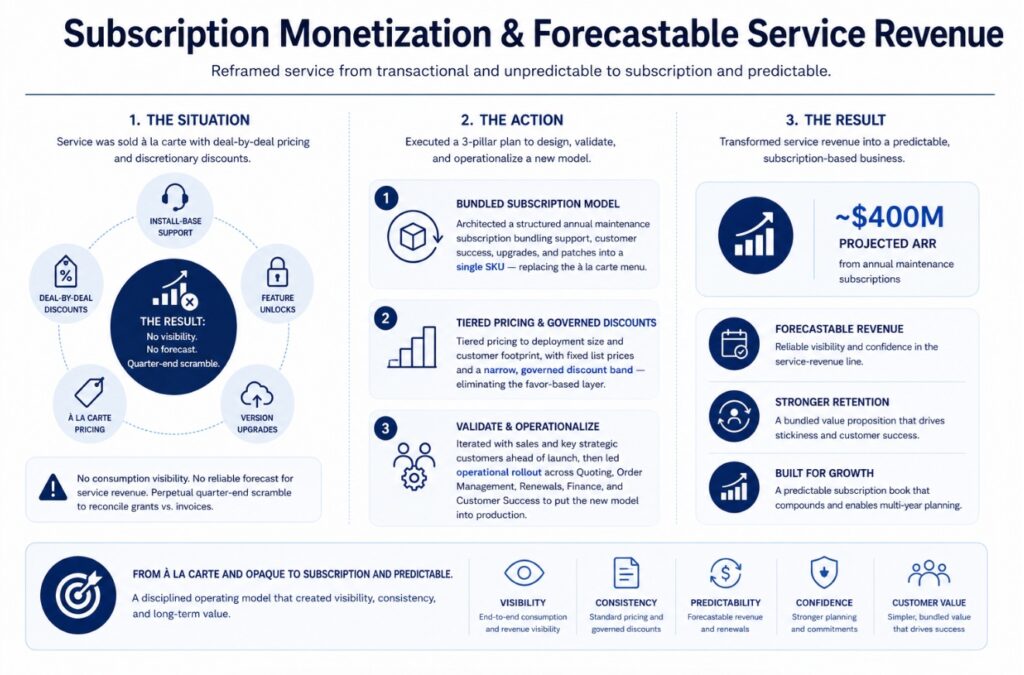
The Result. The reframed offering produced a forecastable annual maintenance line projected at ~$400M ARR — moving service revenue from an opaque, transactional stream into a predictable subscription book that compounded retention and supported multi-year planning.
Innovation Portfolio Governance & Commercialization
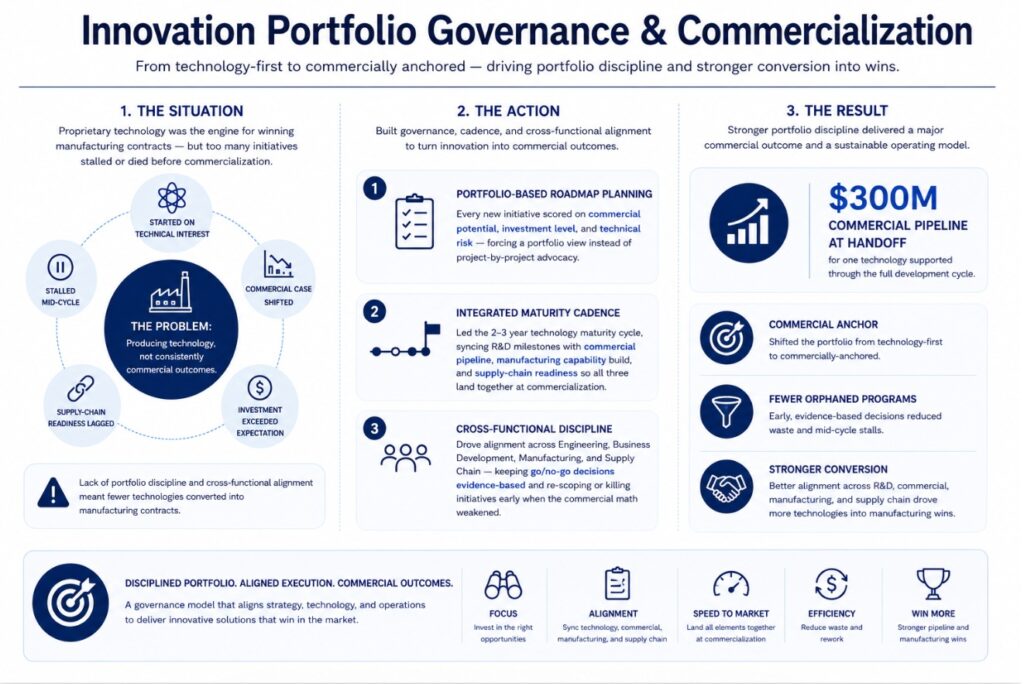
At Flex’s Innovation Center, proprietary technology development was the engine for winning manufacturing contracts — but new initiatives were too often started on technical interest alone, then stalled mid-cycle when the commercial case shifted, investment exceeded expectation, or supply-chain readiness lagged the technology. The center was producing technology, not consistently producing technology that converted into contracts.
The Action.
- Built the roadmap-planning process: every new initiative scored on commercial potential, investment level, and technical risk — forcing a portfolio view in place of project-by-project advocacy.
- Led the operational cadence across the 2–3 year technology maturity cycle, syncing R&D milestones with commercial pipeline development, manufacturing capability build, and supply-chain readiness so all three landed together at commercialization.
- Drove cross-functional discipline across Engineering, Business Development, Manufacturing, and Supply Chain — keeping go/no-go decisions evidence-based and re-scoping or killing initiatives early when the commercial math weakened.
The Result. One technology I supported through the full development cycle exited with a $300M commercial pipeline at handoff — and the broader portfolio shifted from technology-first to commercially-anchored, with fewer orphaned programs and stronger downstream conversion into manufacturing wins.